

This is something I’ve been thinking about all winter and into spring — not as an abstract idea, but as something I keep seeing through my camera. Each week in my Through My Lens series, I post a single street photograph. Over the past six weeks, a pattern has emerged. A recurring posture. A repeated moment. People on the verge of participation, not yet in it.
In February, I posted an image of children leaning over a ferry railing, watching what was happening below. They were completely absorbed — elbows on the rail, chins forward, eyes tracking. They were not disengaged. They were doing something quite focused: reading a situation before deciding what to do about it.
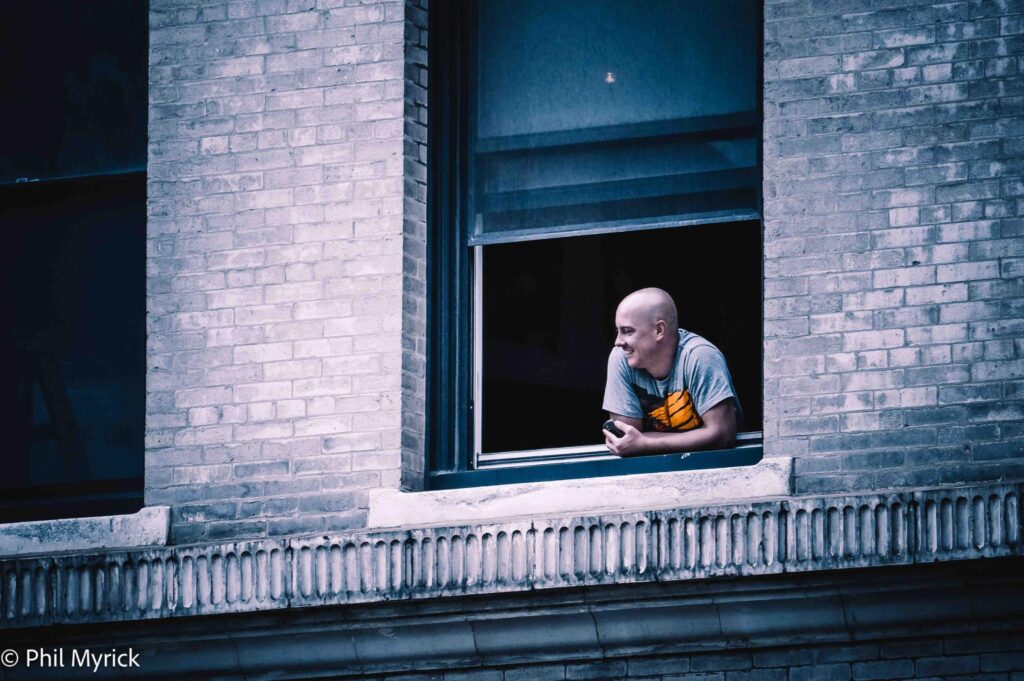
Another image: a man leaning out of an upper-story window, smiling at the street. Not on the street. Watching it. Taking obvious pleasure in the watching itself, before any question of joining arose.
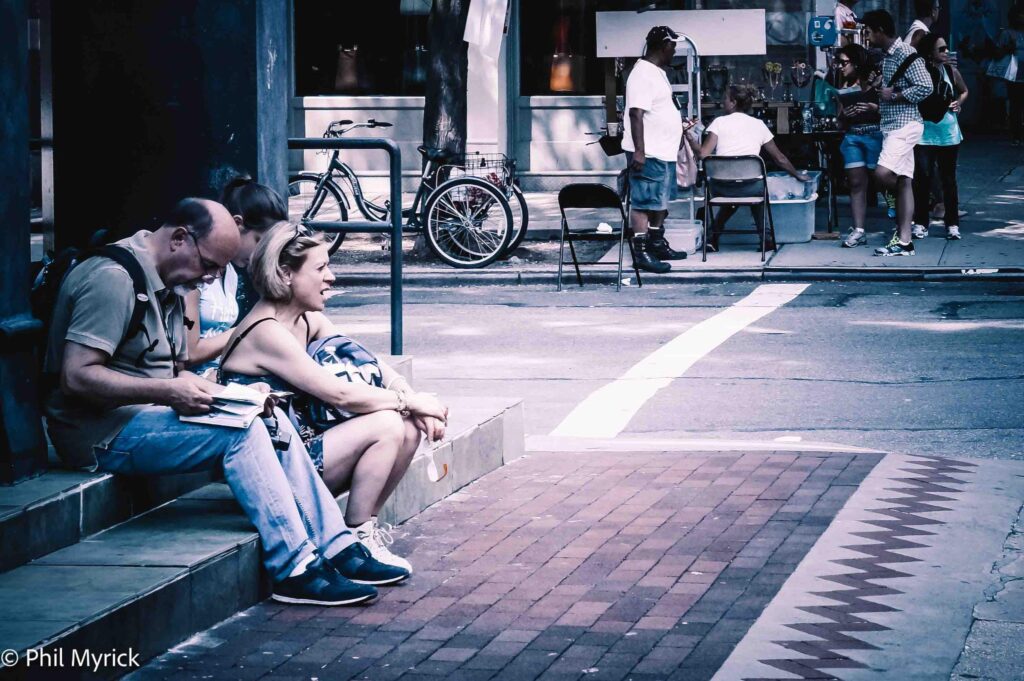
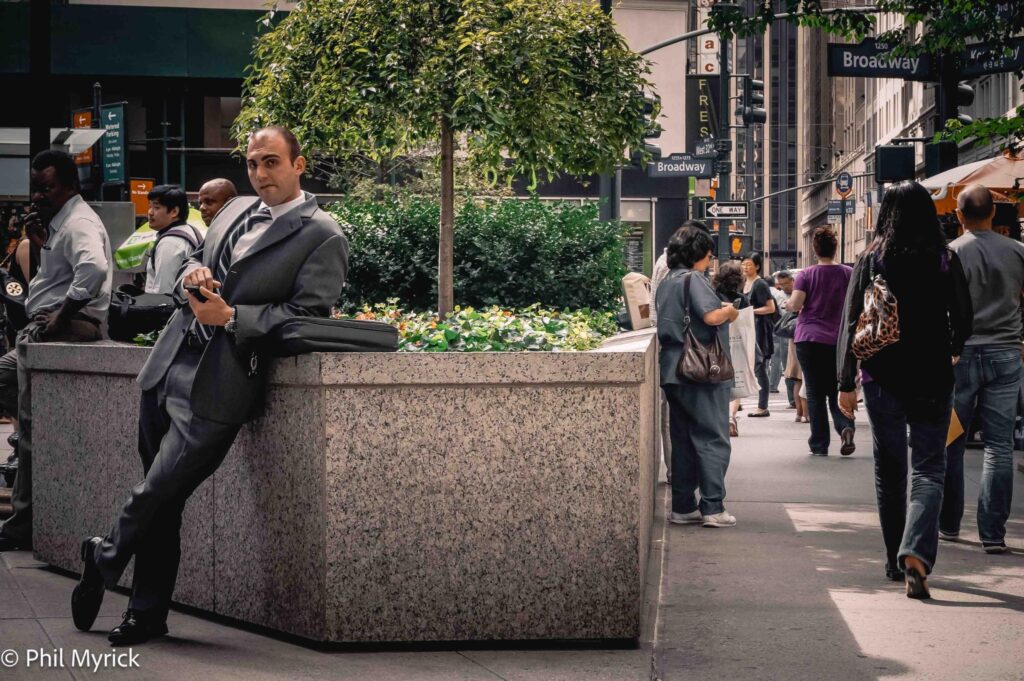
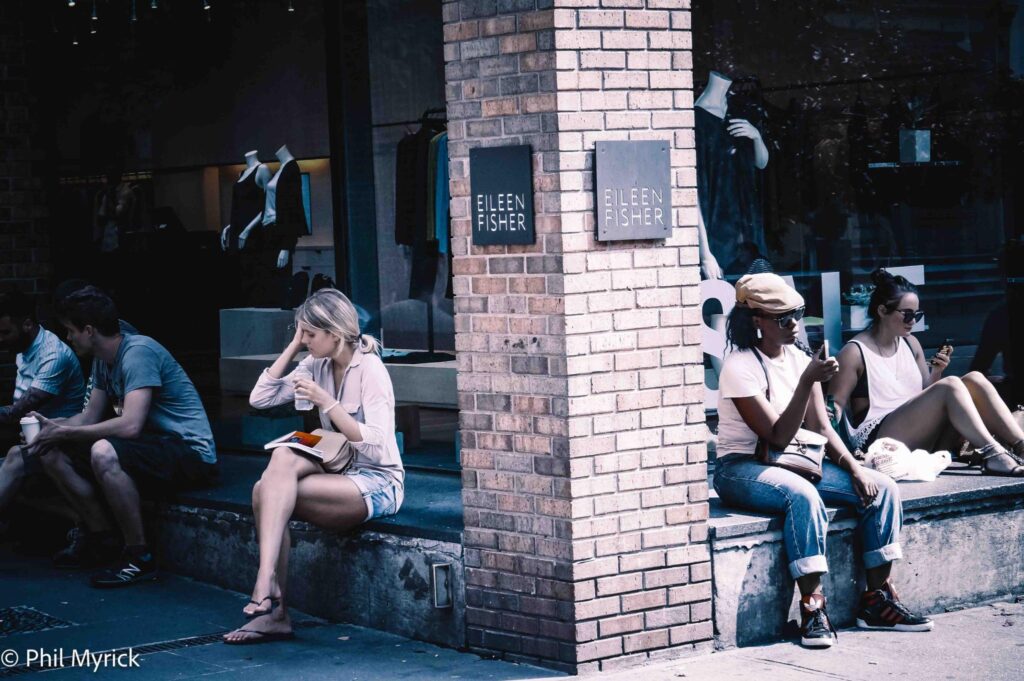
Then a couple parked on a curb, the whole city scene receding behind them. Then a suited man pressing his back against a granite planter, the sidewalk streaming past. People occupying a brick storefront ledge — sitting, waiting, observing — using an edge the city accidentally provided. Three people against a stone facade, each absorbed in a phone, spaced apart at careful intervals, all of them using the wall the same way: as a place to be in public without being fully in it.
Six images. And in each one, the same underlying behavior: people finding a position from which to be present without committing.
The Moment that Urban Design Keeps Missing
I’ve been calling this “the moment before joining in.” It’s a phase of public life that almost never appears in planning documents or design briefs. It has no budget line. It doesn’t show up in activation plans or programming calendars. And yet it may be the hinge on which everything else turns.
Here’s what I mean. When we design public spaces — plazas, parks, campus quads, transit halls — we tend to design for the moment of full engagement. The fountain you play in. The seat you take. The event you attend. We optimize for participation as though it begins the instant someone arrives. But it doesn’t. It begins earlier, in a phase of orientation that is behavioral, not conscious — a scan of the social environment for cues about what’s acceptable, what’s available, what role there might be for you here.
Environmental psychologists have a term for the settings that structure this behavior. They call them “behavior settings” — the recognizable configurations of space, activity, and social norm that tell people how to be in a place. When a space communicates its behavior settings clearly, people can navigate it. When it doesn’t, they can’t — and they leave, often without knowing why.
The moment before joining in is when people read those settings. And what they need in order to read them, it turns out, is not instruction. It’s affordance. A ledge to lean on. A step to sit on. A threshold position — neither fully inside the action nor fully outside it — from which they can watch, assess, and decide.
What Good Public Realm Design Should Recognize
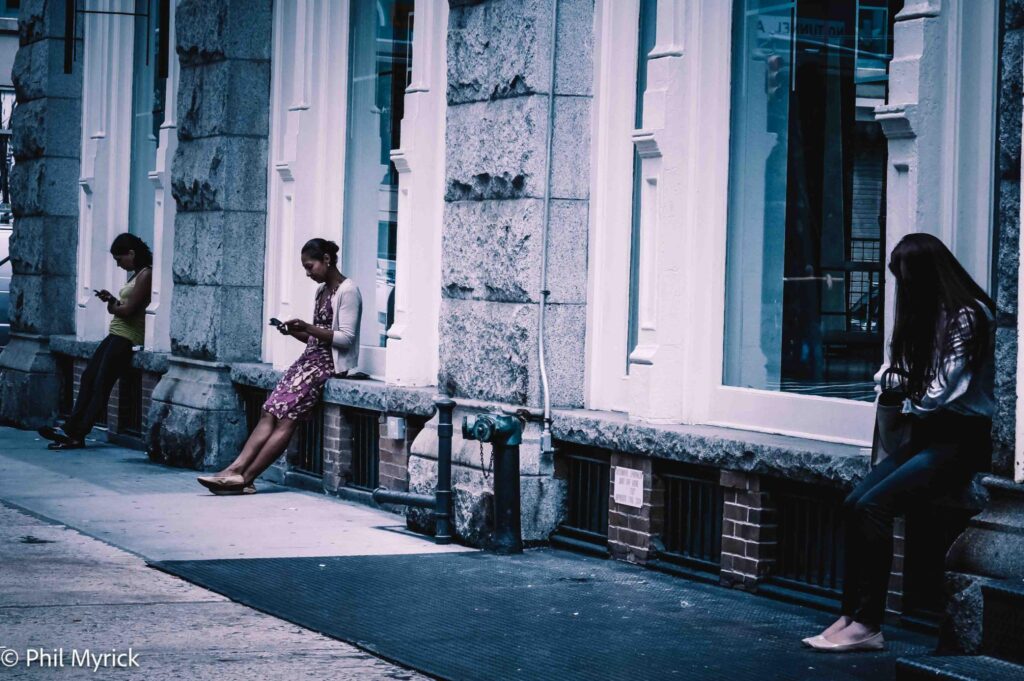
This is what edges do. It’s why a granite planter attracts a man in a suit on his lunch break. It’s why a brick storefront ledge fills up before the plaza does. It’s why the man in the window is smiling: he has a perfect vantage point, a position of partial participation, a way of being in the life of the street without any social obligation whatsoever.
Spaces that lack these positions — the open, featureless plazas with nothing to lean on and nowhere to hover — tend to feel inhospitable in a way that’s hard to articulate. They’re not dangerous. They’re not unwelcoming exactly. They’re just demanding. They require full commitment from the moment of arrival. And for most people, in most moments, that’s too much to ask.
When Public Spaces Get This Right
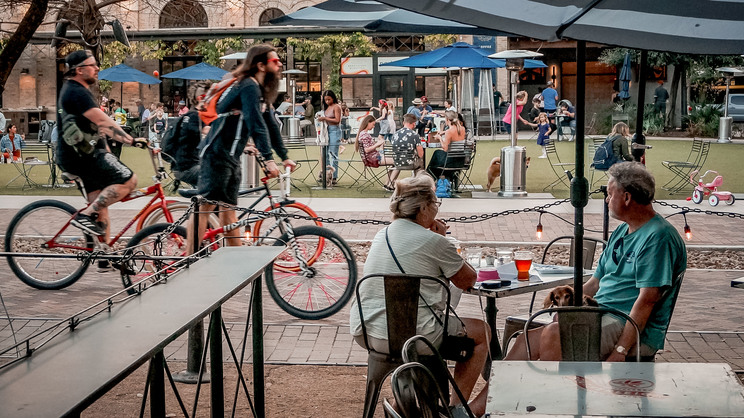
The best public spaces I know are generous about this. Pearl in San Antonio has spent twenty years accumulating edges, thresholds, shaded corners, and porous indoor-outdoor zones that allow people to be present in a dozen different ways before they’re fully in. Discovery Green in Houston works similarly — it’s not one space but a layered set of behavior settings, each with its own position for hovering and watching before joining. The great market streets and campus quads that people return to year after year have all solved the same problem: they make partial participation easy, even comfortable, before they ask for anything more.
Designing Public Spaces That Allow for Slow Entry
This has practical implications for everyone working in urban design, campus planning, and real estate development. Programming matters — but it can’t do the work of spatial design. You can schedule an event in a plaza, but if the plaza offers no edges, no shelter, no position from which people can watch before they join, the event will draw fewer people than the space is capable of holding. The hardware has to support the software. The space has to make room for the moment before.
I’ve been trying to see that moment clearly in these images — not to romanticize the hesitation, but to take it seriously as a design condition. Every person on a ledge, every watcher at a window, every couple on a curb is telling us something about what the space afforded them. They found a position. The space made one available. That’s not nothing. That’s the beginning of public life.
Where have you noticed people hovering at the edges — watching before deciding to step in?