
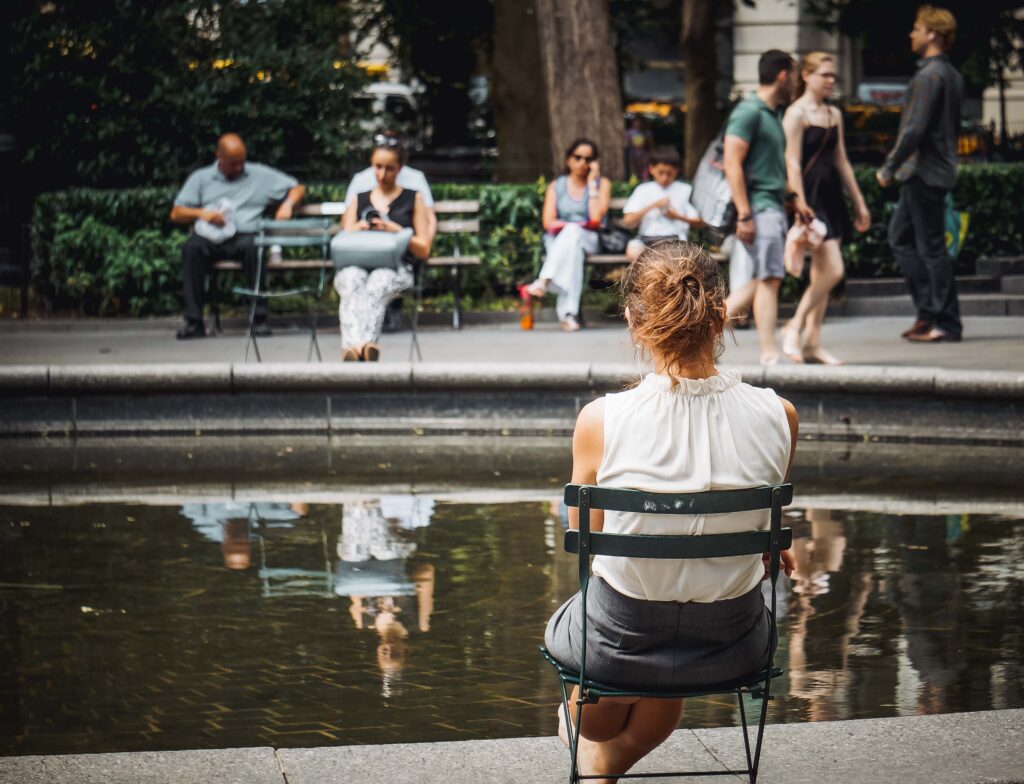
Ask most people what makes a public space work and they will point to its design or its events: the fountain, the stage, the summer concert series. Watch the people who use one every day and the picture changes. What holds the place together is the woman at the coffee cart, the group of chess players who gather every afternoon, the smiles exchanged with people you think you’ve seen before.
These small, low-intensity encounters are a critical part of the social life of a public space, and they come from repetition. A festival fills a plaza once. A daily rhythm produces regulars, and regulars, people who recognize each other without quite knowing each other, are as much a part of a city’s social infrastructure as the benches they sit on.
Planning documents miss all of this because none of it is spectacular. But these moments add up. They turn a stranger into a face you recognize, and a face you recognize into the feeling that a place is partly yours.
Familiar strangers and the weak ties that make public space work
Not every valuable interaction involves speaking. Sitting on the same bench, sharing a patch of grass, watching the same view: none of it requires a word. You may never learn the other person’s name and still leave knowing you were not the only one who wanted to be here, at this hour, in this place.
Sociology identified this phenomenon at least fifty years ago. Stanley Milgram called these people familiar strangers: the ones you see at the same transit stop, the same counter, the same corner, week after week, and never speak to. Erving Goffman described the rules of the encounter, the glance and the look away that he called civil inattention. It is easy to read all this as nothing happening. Milgram’s finding was that it is not nothing. Familiar strangers are far more likely to speak when the routine is disrupted, by a delayed train, a storm, a shared inconvenience. The relationship is real; it just has not been activated yet.
The research since then has only firmed this up. Gillian Sandstrom and Elizabeth Dunn found that a brief, real exchange with a barista left people with a stronger sense of belonging than an efficient transaction did, and that the number of small weak-tie interactions in a day predicts how connected people feel that day. Nicholas Epley and Juliana Schroeder found that commuters asked to talk to a stranger on the train enjoyed the ride more than those told to keep to themselves, though nearly everyone predicted the opposite. And the idea has left the journals: the World Health Organization now has a Commission on Social Connection, Eric Klinenberg’s Palaces for the People made the case that libraries, parks, and playgrounds are the physical basis of social life, and Reimagining the Civic Commons has spent a decade measuring whether public spaces actually mix people across income lines. What most of that work still lacks is a description of the physical settings that produce the weak tie. That is our job.
So a public space can produce two important things. One is exchange: a word, a look, a transaction. The other is belonging, which can be as simple as being in the same place often enough to recognize the people around you. Exchange needs proximity and a reason to linger. Belonging needs repetition.
Why regular programming beats big events in public space
That word, repetition, is the one most public space managers underrate, and it is where the argument gets uncomfortable. Large, infrequent events can work against the everyday exchange.
Low-intensity interaction depends on recognition. You nod to the person at the next bench because you have seen them there before. You ask the vendor how the peaches are because you asked her last week. None of that can happen unless the same people are in the same place at the same time, repeatedly. Meanwhile a big annual festival fills the plaza once and empties it, and nobody who came learns anyone’s face. A coffee cart that opens every morning at seven, in the same spot, does the opposite. Within a month the people who pass it have become a cast of regulars who know each other by sight, which is the precondition for everything else in this issue.
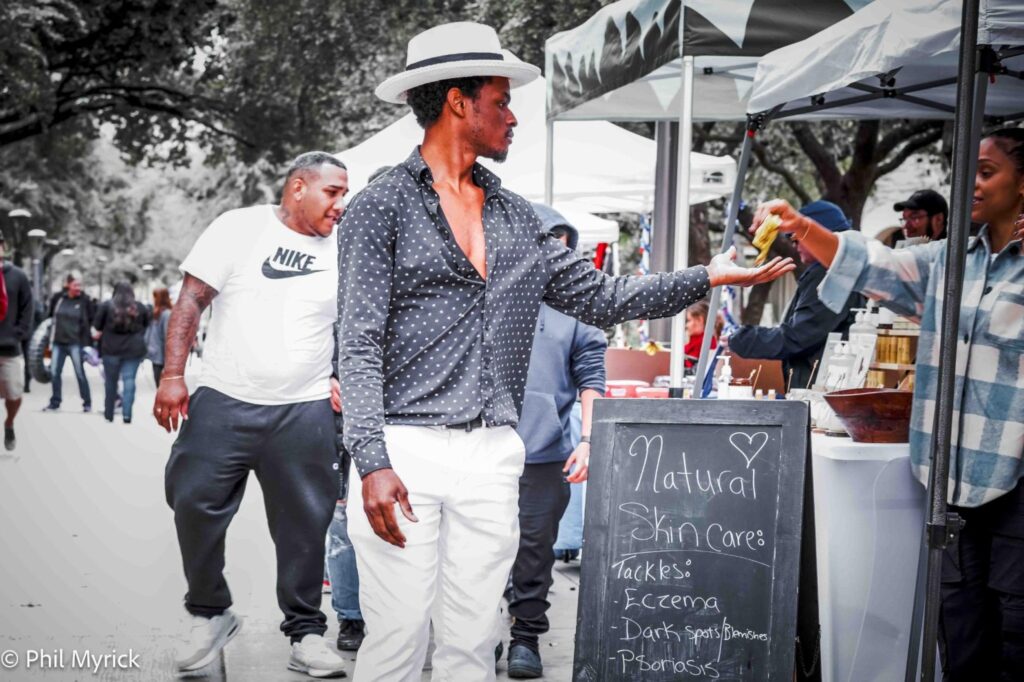
This is not an argument against programming. My own research keeps confirming that programming and location are the two strongest predictors of a space’s success. It is an argument about which programming. The events that build a social life are the ones that recur: the same modest thing, at the same hour, on the same day, for years. Any farmers market going full tilt is the proof. Its power is not any single stall. It is that the market is there every Saturday, so the vendors become known figures, the shoppers become regulars to each other, and a stretch of street becomes a place where you expect to see people you recognize.
How public space design gives strangers permission
There is a second reason markets work, and Goffman had a term for it. According to Goffman, most public space is governed by civil inattention, where talking to a stranger is a small breach. However, some settings are open regions, where a conversation needs no excuse. Places like dog runs, bar counters, playgrounds, market stalls. The setting, not the personalities of the people in it, decides which one you are standing in.
William H. Whyte called the mechanism triangulation: an object, activity, or experience that gives two strangers a shared reason to notice each other. It starts with attraction. Something pulls two people’s attention to the same spot at the same moment, a street performer, a chess game, a dog doing something ridiculous, and once they are both looking at it, a comment to the person beside you is no longer a breach. The attraction comes first. The permission follows from it. The research on the classic props is clear: people walking a dog are approached and spoken to by strangers at several times the rate of people walking alone, and small children do the same work for their parents. Dogs and toddlers are some of the most effective social infrastructure most cities have, and few cities spend enough attention on them.
Dogs and toddlers open conversations by accident, but a few places now build the opening on purpose. Britain’s “Happy to Chat” benches, begun by a police force in 2019 and now in parks across the country, are nothing more than a sign on a bench that says sitting here means you are open to conversation. The Chatty Cafe Scheme puts a designated table in cafes and public spaces where anyone can sit down and talk. These are somewhat crude tools, but they are open regions built on purpose, and they exist because someone noticed that the default setting of most public space is silence.
Here is a question I have started asking of design teams, alongside the -ing list. Take every element in a plan and ask: does this give strangers an opportunity to speak? A bench facing a blank wall, no. A bench facing a splash pad, yes. A kiosk selling something worth asking about, yes. An open lawn with nothing on it, no. Go through the plan this way rather than by square footage and you will see right away where exchange can happen and where it cannot.
The small negotiations that build social connection
A related rule is easy to state and routinely violated: leave in the small negotiations. The movable chairs in many urban parks work partly because they force a question, is this taken, do you mind if I pull this over, several hundred times a day. Communal tables, a single shared condiment station, one bike pump at the trailhead, a queue at a food truck window: each requires a small transaction between people who otherwise had no reason to speak. Design that removes every micro-negotiation, in the name of efficiency or clean sightlines, removes every micro-conversation with it. The affordance is not just the chair. It is the sentence the chair requires.
The public character: how vendors become social infrastructure
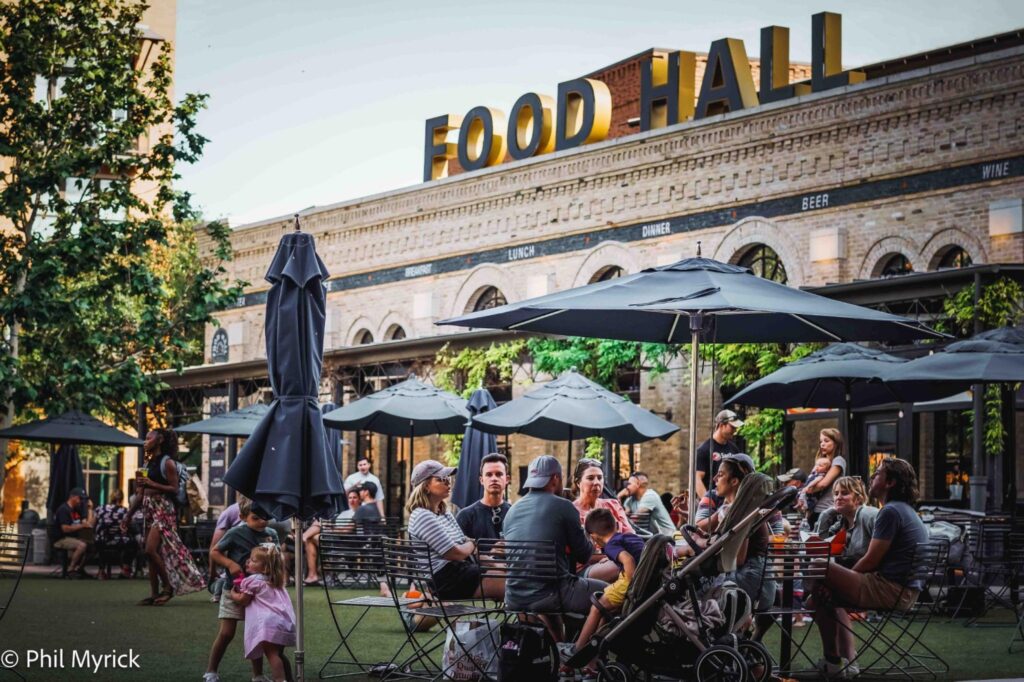
Food does two things at once for social life, and that is why it does the heaviest lifting in nearly every successful public space I have studied. First, it stops people. Eating and drinking hold a person in place for ten or twenty minutes, in view of other people doing the same thing, and most low-intensity interaction happens in exactly that window. Second, it puts a person behind a counter whose job is to talk to everyone. Jane Jacobs called the storekeeper who knows the whole street a public character. Every good market stall, coffee cart, and ice cream window has one, and that holds whether the food arrives as a full market, a lone kiosk, a food truck, a corner cafe, or a sit-down restaurant.
The public character does not even need the counter. When I was at Project for Public Spaces we often used an example from New Haven: a newsvendor, a species now nearly extinct, who stood on the same corner every morning with a bag of papers and had become the mayor of the block. He knew everyone, everyone stopped, and introductions happened around him that would not have happened anywhere else on the street. What made him work was a fixed spot, a fixed hour, and a reason for people to pause.
Measure it on a Tuesday
None of this photographs as well as a ribbon-cutting or a festival stage, and that is the problem with how public investment gets evaluated. A plaza judged by its event calendar will always look underused between events, even when it is working exactly as it should.
So measure the everyday instead. Whyte’s simplest metric still holds: count the people standing or sitting against the people passing through, and watch that ratio over time. Or try a fifteen-minute count of greetings, the nods and hellos and brief exchanges between people who did not arrive together. Do it on an ordinary Tuesday with nothing scheduled. If the numbers are there, the space is working, whatever the calendar says.
The next time you are in a public space on a day when nothing is scheduled, watch what people do anyway. That is the real program.
A Placemaker’s Place is a ~quarterly newsletter on the science and practice of vibrant public spaces, from Phil Myrick, former CEO of Project for Public Spaces and founder of Phil Myrick LLC. For monthly, buyer-facing dispatches on placemaking and mixed-use development, subscribe to The Visionary Developer, or find both at philmyrick.com/blog.