

A developer called me eighteen months into a project last year and asked for help with the programming strategy. The buildings were designed. The anchor retail leases were signed. The public realm had been through entitlements and was in construction documents. He wanted to know how to make the central plaza feel alive when it opened.
I told him the honest answer, which was that most of the decisions that would determine whether the plaza felt alive had already been made, and that the programming strategy I could write him would be working downstream of all of them. He could still get a respectable outcome. He could not get the outcome he was picturing.
That conversation is not unusual. It might be the single most common conversation I have with developers.
The pattern is that placemaking expertise gets engaged at the moment the developer first feels nervous about whether the place will work. That moment almost always comes too late to affect the decisions that most shape whether it works. By the time the question becomes urgent, the answer has mostly been written.
It is worth being precise about which decisions get locked in when.
Mistake one: programming strategy after design is complete
Programming is the most visible part of placemaking. It is also the part developers think of first when they think of placemaking at all. So it is the easiest thing to add late.
The problem is that programming can only work with the behavioral canvas the buildings have given it. A weekend market needs a plaza with the right proportions, the right sun exposure, the right relationship to the street, the right back-of-house infrastructure, and the right edge conditions to support vendors. A live music program needs acoustic conditions that do not require subwoofers pointed at residential windows. A family-oriented activation needs sightlines, shade, water, and seating in the right combinations.
When the building plans are done, those canvases are fixed. A good programmer can squeeze real value out of an imperfect canvas, but the ceiling is set by the architecture. Engaging programming expertise after design lock-in is optimizing within a constraint that did not have to be there.
Mistake two: retail curation after the anchor tenants are signed
The tenant mix shapes the daily rhythm of a project more than any other single factor. The first two or three retail anchors define what kind of place this is. They define the time of day people show up, the demographic they expect to see, the price point they expect to encounter, and the kinds of operators who will sign on later because the first ones did.
By the time a developer asks “should we be thinking about this from a placemaking perspective,” the first two anchors are usually already signed. The leasing team has done what leasing teams do, which is optimize for credit, rent, and speed. Those are the right criteria for a single asset. They are the wrong criteria for the front end of a tenant strategy that is supposed to produce a place.
Bringing placemaking thinking in after the anchors are signed is optimizing around a decision that has already been made. The remaining tenants get filtered through whatever character the anchors established, whether that character was what the developer actually wanted or not.
Mistake three: public realm design after the site plan is approved
Public realm design tends to happen after entitlements, when the broad strokes of the site plan are settled and the question becomes how to detail the spaces between buildings.
By that point the spaces between buildings have already been defined, mostly by decisions that had nothing to do with public realm. Parking ratios determined how much surface area went to cars. Loading requirements determined which edges were available for pedestrians. Setbacks determined how generous the public spaces could be and which edges of which buildings faced them. Stormwater determined where grade changes happened.
A skilled landscape architect or public realm designer can do good work inside those constraints. But the constraints did most of the work first. The public realm a project ends up with is largely a residual of decisions made for other reasons in another phase.
The one moment that matters most
The decisions that most shape whether a mixed-use project produces a real place are made in the concept and entitlements phase. Not in design development. Not in construction documents. Not in leasing. In the phase when fundamental questions get answered, usually implicitly, about what kind of daily life this project is supposed to generate.
What is the parking strategy, and where does it go? That decision shapes whether the project feels like somewhere or like a garage with addresses. Where does the residential go relative to the retail, the office, and the public space? That decision shapes whether the place has eyes on it at six in the morning and ten at night, or only between nine and five. What sequence do the uses come in? That decision shapes whether the place ever reaches the critical mass it needs to become self-sustaining. How permeable are the edges? That decision shapes whether the project knits into the neighborhood around it or sits inside it like a fortress.
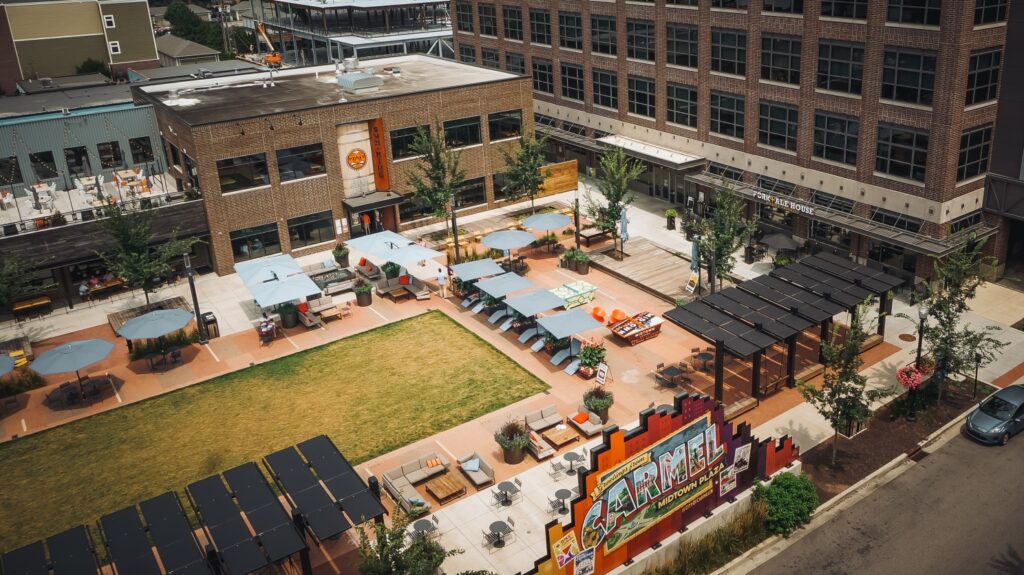
These are not placemaking questions in the usual sense. They are entitlements questions. Capital stack questions. Site plan questions. Phasing questions. They get answered by development executives, civil engineers, traffic consultants, and lawyers, often without anyone in the room thinking of them as decisions about daily life.
But that is what they are. Every one of them is a decision about daily life. And once they are made, the project’s character is mostly written. Everything that happens afterward, including everything the placemaking consultant gets asked to do later, is working inside the envelope those early decisions established.
What this means practically
I am not suggesting developers hire a placemaking consultant the day they close on the land. The placemaking discipline does not produce concept-stage deliverables in the way an architect or a traffic engineer does, and most developers do not have a clear point of entry for it that early.
But the questions placemaking thinks about are exactly the questions that get answered, implicitly, at concept. Bringing placemaking thinking into the room at that stage, even informally, even as a half-day conversation with a small team, changes which questions get asked and how the early decisions get framed. It is not about adding a deliverable. It is about adding a lens.
The developers I work with who get the most value from placemaking are not the ones who hire it earliest. They are the ones who start thinking about it earliest. By the time they engage a consultant, they have already been asking the right questions for six months.
The next time you start a project, try this. Before the schematic design gets locked in, sit with your team for two hours and ask one question. What kind of daily life do we want this place to generate, and what would we have to be doing differently right now to get there?
Most of what matters about the answer will be visible inside the first hour.
The Visionary Developer is a monthly newsletter for developers, investors, and the teams they work with. If a colleague forwarded this to you, you can subscribe at the top of this page.
For longer-form essays and services see philmyrick.com.
If you’d like to share information and photos of your development, please reach out to info@philmyrick.com